
INCOTERMS
Introduction
Trade + transport = INCOTERMS
INCOTERMS (International Commerce Terms) are international trade (contract) rules — a set of standardised conditions for the delivery of goods in foreign trade.
Trade and transport are destined to go hand in hand. Trade is closely tied to finance (delivering goods as cheaply and quickly as possible), and so it has always shaped — and will keep shaping — the conditions under which transport develops, both technically and in terms of the geography of freight flows.
On the other hand, cheaper transport services allow production to move far from raw-material sources and sales markets. In other words, transport has long been reshaping the face of world trade.
Both trade and transport have a long history, but also a fast-changing present, whose key feature is growing globalisation. Back in the 18th–20th centuries, the growth of international trade in Western Europe and North America led to the emergence of common international trade terms. Today, the convergence of business traditions across regions is obvious, and trade rules are converging as a result. The most important documents in this respect are the rules for interpreting international trade terms (INCOTERMS) and the Vienna Convention.
In 1936, the International Chamber of Commerce (ICC), seeking to unify and clearly describe trade terms, published a set of international trade conditions called INCOTERMS (short for International Commercial Terms), often also referred to as “delivery terms”. The rules were revised in 1953, 1967, 1976, 1980 and 1990. A further version was published in 2000, known as INCOTERMS 2000.
INCOTERMS are a group of three-letter codes that indicate different ways of organising international transport. The terms allow sellers and buyers from different cultures and legal systems to decide at what point responsibility and payment for transport, insurance and customs procedures passes from one party to the contract to the other.
The need to standardise delivery (supply) terms arose for many reasons. As trade with foreign countries grew, so did the number of international transactions — and with it, misunderstandings and disputes over who should pay for transport, or part of it. Such miscommunication mostly stemmed from differing trade traditions that had developed over centuries in different countries.
The accelerating globalisation of later years further sped up the use of INCOTERMS rules in international trade. They help avoid differing interpretations of delivery terms, saving exporters and importers significant time and money that used to be lost.
INCOTERMS 2000 has been translated into more than 20 languages and is readily available to buyers and sellers worldwide.
By choosing the appropriate delivery terms, the buyer and seller can agree on price without uncertainty about who pays for what. Following INCOTERMS is not mandatory in every country. However, when problems arise, it is much easier to determine who is responsible for what when the use of INCOTERMS has been specified in the international sale-purchase contract.
INCOTERMS delivery terms are divided into several groups, each marked with a three-letter acronym that defines the limits of the seller’s responsibility. The chosen terms must be written into the purchase or transport contract. If INCOTERMS are used, this must be done very precisely — avoiding any room for interpretation.
Next to the three-letter INCOTERMS abbreviation, the named place of departure or delivery must always be stated, for example: “FOB Hong Kong INCOTERMS 2000”, “DDU Vilnius airport INCOTERMS 2000”, “FCA Rotterdam INCOTERMS 2000”. These delivery terms do not transfer title to the goods.
Nor do they specify the moment when goods pass from seller to buyer — this must be stated in the trade contract. In practice, it is usually the carrier who determines when goods become the buyer’s property, “guided” by whichever party pays for the carriage. The exception is sea transport, where original ocean Bills of Lading are used and title belongs to the holder of the bill. INCOTERMS cover only the sale of goods and are not related to the sale of services or intangible assets.
INCOTERMS groups
INCOTERMS 2000 are divided into four groups:
- Group E — departure
- Group F — main carriage unpaid
- Group C — main carriage paid
- Group D — arrival
Group E — departure
This first group contains only one INCOTERMS term — EX Works (EXW).
Ex Works means the seller makes the goods available to the buyer at the seller’s own premises (factory or warehouse). Export clearance is not carried out. The seller has no obligation to load the goods onto the means of transport arranged by the buyer. All responsibility for loading, carriage and customs clearance falls to the buyer. Ex Works applies to all modes of transport.
Group F — main carriage unpaid
The second group contains three INCOTERMS terms — FCA, FAS and FOB.
1. FCA (Free Carrier) means the seller completes export clearance and delivers the goods to the carrier named by the buyer, at a place named by the buyer. If that place is the seller’s premises, the seller is responsible for loading the goods onto the means of transport arranged by the buyer; otherwise, this obligation falls to the buyer. FCA applies to all modes of transport.
2. FAS (Free Alongside Ship) means the seller delivers the goods alongside the vessel named by the buyer, at the loading berth of the port of shipment. The seller also completes export clearance. The buyer is responsible for all further costs at the port, as well as carriage. The buyer chooses the carrier. FAS applies only to sea and inland waterway transport.
3. FOB (Free On Board) terms are similar to FAS, except that the seller is responsible for loading the goods onto the vessel. The seller also completes export clearance. The buyer chooses the carrier. FOB likewise applies only to sea and inland waterway transport.
Group C — main carriage paid
The third group contains four INCOTERMS terms — CFR, CIF, CPT and CIP.
1. CFR (Cost and Freight) applies only to sea and inland waterway transport. CFR means the seller is responsible for delivering the goods to the port named by the buyer. The seller chooses the carrier. The seller is not responsible for loss of or damage to the goods during carriage — that risk lies with the buyer.
2. CIF (Cost, Insurance and Freight), like CFR, applies only to sea and inland waterway transport. The difference between CIF and CFR is that the seller must insure the goods during carriage, since the seller is responsible for loss or damage during transport. The seller chooses the carrier.
3. CPT (Carriage Paid To) is similar to CFR but applies to all modes of transport. The seller undertakes to deliver the goods to a place named by the buyer. The seller chooses the carrier. The seller is not responsible for loss of or damage to the goods during carriage.
4. CIP (Carriage and Insurance Paid To) applies to all modes of transport. The seller chooses the carrier and delivers the goods to a place named by the buyer. The seller is responsible for loss of or damage to the goods during carriage and must therefore insure them.
Group D — arrival
The fourth group contains five INCOTERMS terms — DAF, DES, DEQ, DDU and DDP.
1. DAF (Delivered At Frontier) applies to all modes of transport, but the final leg must be carried out overland (by road or rail). The seller is responsible for delivering the goods to a place at the border named in the trade contract, located before the customs post. The seller is not responsible for unloading the goods at destination.
2. DES (Delivered Ex Ship) applies only to sea and inland waterway transport. The seller delivers the goods to the port named by the buyer. The goods become the buyer’s responsibility while still on board the vessel — i.e. the seller is not responsible for unloading. The buyer is responsible for import procedures.
3. DEQ (Delivered Ex Quay) is chosen when the seller is to be responsible for unloading the goods from the vessel onto the quay at the port of arrival. DEQ applies only to sea and inland waterway transport. The buyer is responsible for import procedures.
4. DDU (Delivered Duty Unpaid) applies to all modes of transport. The seller undertakes to deliver the goods to a place named in the trade contract but is not responsible for unloading them from the means of transport. The buyer is responsible for import procedures. If import procedures are delayed through the buyer’s fault, the buyer must cover any resulting additional costs.
5. DDP (Delivered Duty Paid) also applies to all modes of transport. The seller undertakes to deliver the goods to a place named in the trade contract but is not responsible for unloading them from the means of transport. The seller is responsible for import procedures and duties in the country of arrival. If the buyer wishes to pay part of the duties, this must be stated in the trade contract.
INCOTERMS in practice
The most commonly used INCOTERMS are EXW, FCA, FOB, CIP and DDU. However, their “popularity” varies by region. For example, FOB and CIP are often chosen in Asia, while EXW and DDU are more common in America.
Misinterpretation of INCOTERMS is not uncommon. The most frequent mistake concerns the use of FOB. Although under INCOTERMS 2000 FOB applies only to sea transport, this term is often mistakenly chosen for air freight as well.
It is important to note that only two INCOTERMS (CIF and CIP) address cargo insurance.
Although the seller is obliged to insure the goods against damage or loss during carriage, the buyer should find out what kind of insurance this is. Sellers often choose a minimum insured amount that would not be sufficient to cover damages, so buyers are advised to arrange additional cargo insurance.
The authors of INCOTERMS 2000 themselves point out a common misconception — treating INCOTERMS as relating primarily to the transport of goods rather than to the sale-purchase contract. In fact, they relate only to the commercial relationship between buyer and seller as set out in the sale-purchase contract.
Another common misconception is that INCOTERMS cover all the obligations that the buyer and seller need to agree on in their contract. However, an international transaction is still governed by separate contracts relating to carriage, insurance, customs brokerage and so on.
Significant differences in the legal treatment of INCOTERMS still exist between countries. In some countries, specifying INCOTERMS for import/export operations is mandatory; in others, the rules are only recommendatory, and it is up to the contracting parties to decide in what context the responsibility terms are included in the trade contract.
When a contract states that the parties will follow INCOTERMS 2000, or a chosen three-letter term (EXW, DDU, etc.), everything becomes much simpler — should any unforeseen problems unfortunately have to be resolved in court. There are several other reasons why it is useful to specify INCOTERMS in a sale-purchase contract:
- Negotiating becomes much easier for both sellers and buyers, since the three-letter code alone makes clear what responsibilities each negotiating party must take on.
- The contracting parties no longer need to clutter the contract text with unnecessary descriptions of each party’s responsibilities — the contract becomes very concise, since INCOTERMS terms are clear, standardised and cover most essential issues.
- Various complications can also arise when fulfilling contract terms. Applying INCOTERMS greatly facilitates finding the best solution for all parties, so everything is resolved quickly.
What to pay attention to
Factors to consider when setting delivery terms:
- Under Group C, the exporter pays the transport costs, so it is important to specify exactly the delivery point up to which carriage must be paid.
- Under Group C, the exporter is considered to have fulfilled its obligations in the country of dispatch. This means the exporter’s obligations include paying for normal carriage of the goods to the destination, while the risk of accidental damage or loss, and any additional costs arising after the goods are handed to the carrier, fall to the buyer.
- When using Group C terms, the parties often clarify the extent to which the exporter guarantees carriage. The term “landed” is often added alongside it.
- Buyers often ask for the wording “unloading (dispatch) no later than…” to be added next to Group C terms. However, such a term is ambiguous, since under this group of terms any risk of delay during carriage falls to the buyer.
- Under Group D terms, the exporter is responsible for delivering the goods to the agreed point or port. The exporter bears all risk and pays all costs of delivering the goods to the agreed place.
- Under DAF, DES, DDU and DEQ terms, the exporter is not required to complete the necessary import formalities, whereas under DDP the exporter must complete all import formalities for the goods.
- The risk of loss or damage to the goods, as well as the obligation to pay certain costs, passes from the exporter to the buyer from the moment the exporter fulfils its delivery obligations.
INCOTERMS 2000 diagrams
INCOTERMS will be easier to understand with the help of these diagrams.
You can use this diagram (in Lithuanian):
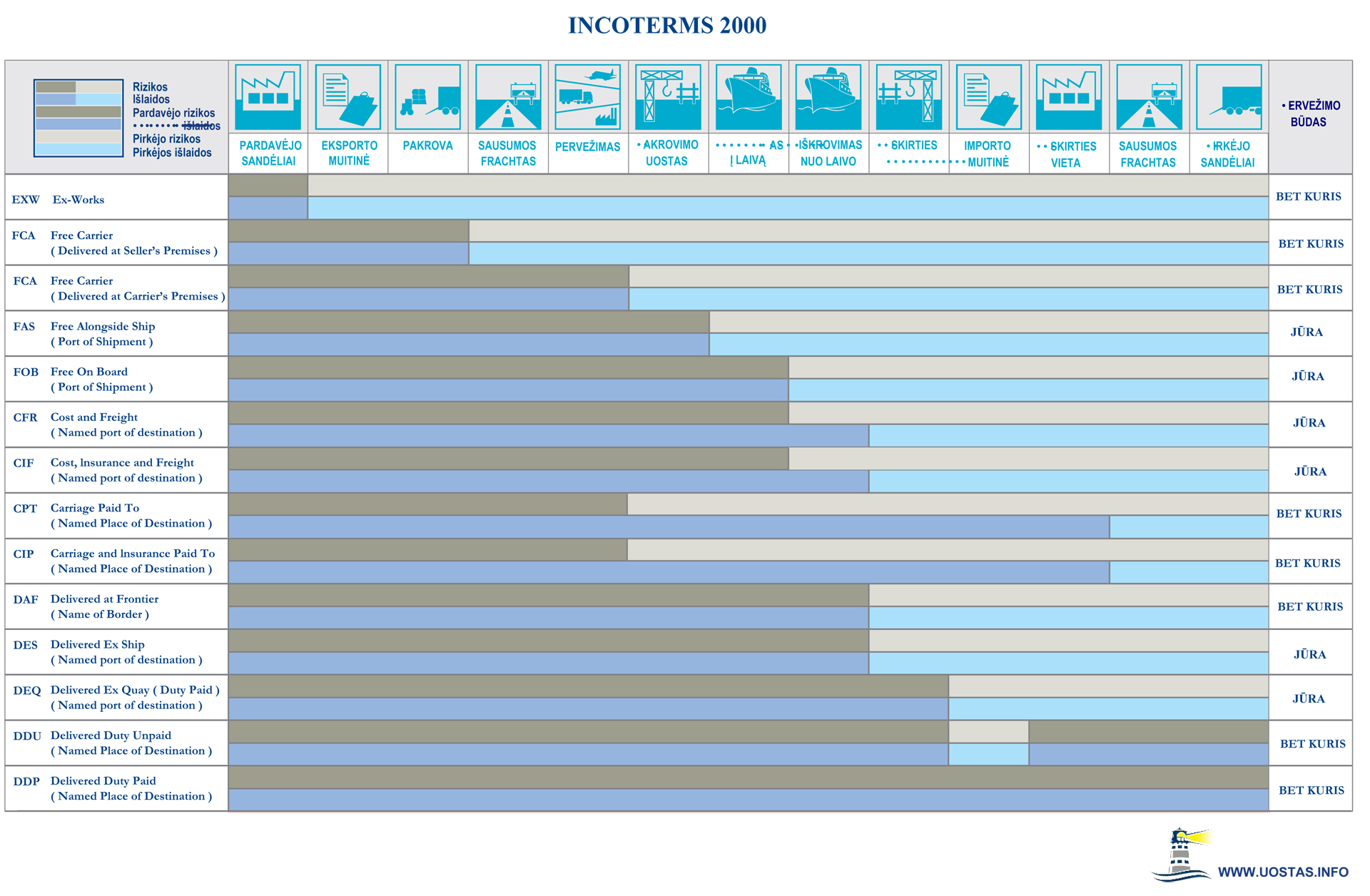
or view another diagram in English:
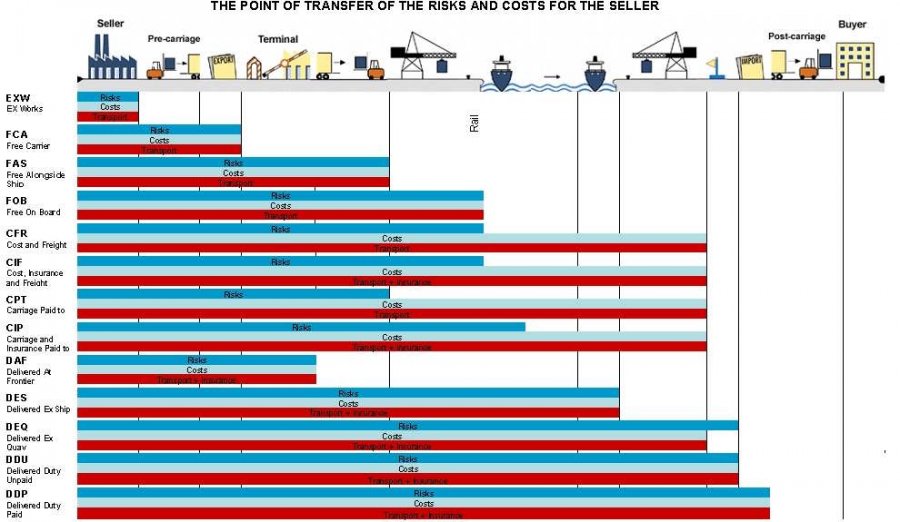
See the INCOTERMS 2010 diagram in the next section.
The main factors in the diagrams are the place of delivery, transport costs, risk and insurance. Different Incoterms rules affect how these factors are split between the seller and the buyer. Sellers will find the second diagram more convenient, as it illustrates how risk, goods and transport costs are divided.
INCOTERMS 2010 — what’s new, and the diagram
From 1 January 2011, a new edition of the international trade terms, “Incoterms 2010”, came into force, reflecting the latest business trends and the evolution of contractual relationships.
These terms, created by the International Chamber of Commerce (ICC), have been used in international trade since 1936. They were last updated in 2000.
In the new “Incoterms 2010” edition, which reflects business realities that changed over the past decade, two terms were dropped and merged with others: DDU (Delivered, duty unpaid), DAF (Delivered at frontier), DEQ (Delivered ex quay, duty paid) and DDP (Delivered, duty paid) were replaced by two new terms, DAP (Delivered at place) and DAT (Delivered at terminal). As a result, the total number of Incoterms dropped from 13 to 11.
It should be noted that even when using Incoterms, the application of the contracting parties’ national law cannot be entirely avoided, and this can affect the content of an Incoterms term.
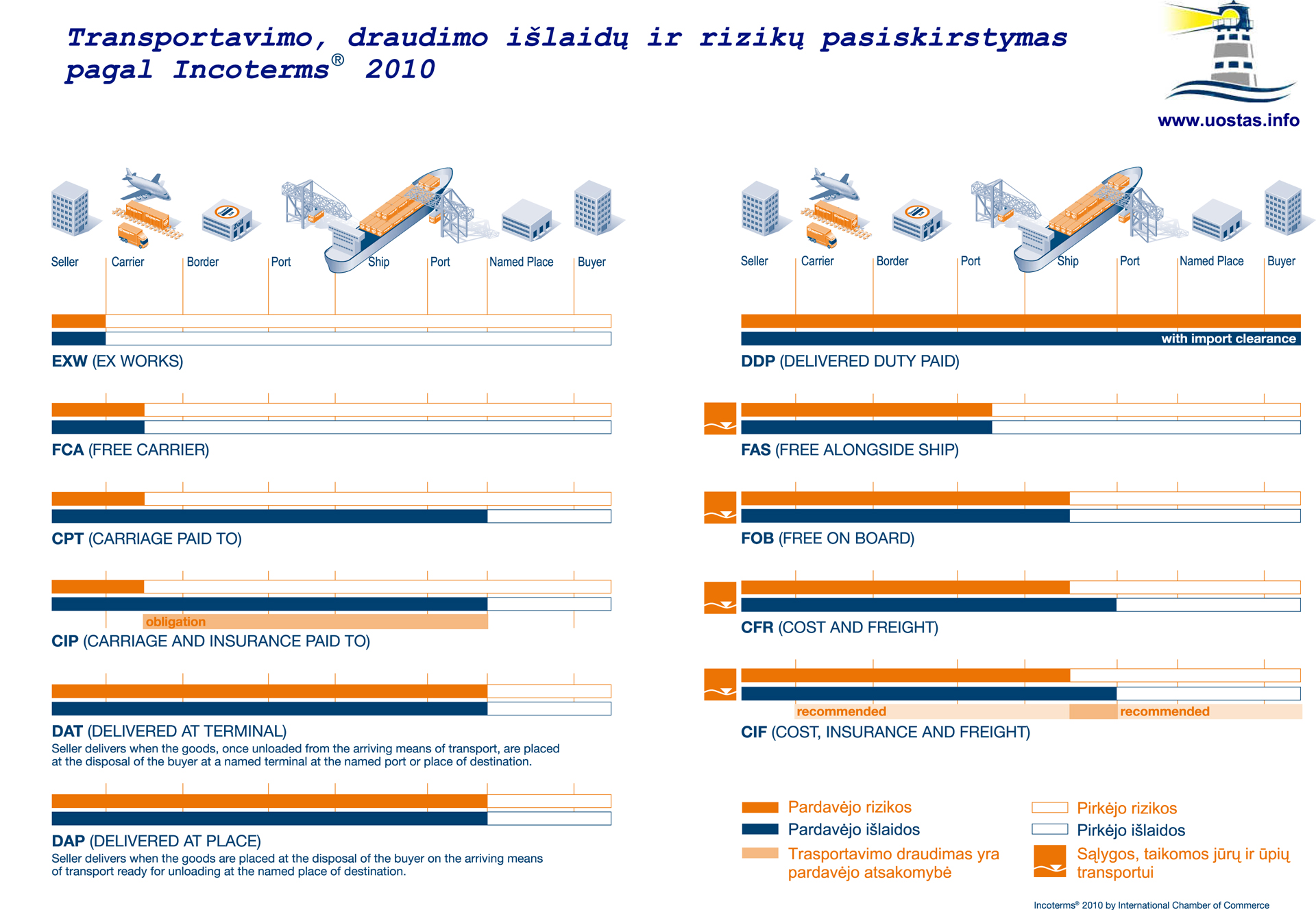
To make the terms easier to use, the grouping of Incoterms has also changed — the new edition distinguishes between terms intended only for sea transport and those intended for any mode of transport other than sea. In addition, reflecting the growth of electronic technology, some documents were replaced with electronic equivalents.
Terms used for any mode of transport:
CIP – Carriage and Insurance Paid
CPT – Carriage Paid To
DAP – Delivered At Place
DAT – Delivered At Terminal
DDP – Delivered Duty Paid
EXW – Ex Works
FCA – Free Carrier
Terms used for sea and inland waterway transport:
CFR – Cost and Freight
CIF – Cost, Insurance and Freight
FAS – Free Alongside Ship
FOB – Free On Board
To further promote the use of Incoterms and explain the terms properly to less experienced users, the new edition also introduces general descriptions for each group of Incoterms, outlining the essential conditions for using specific terms.
If you understand English, you can watch a short presentation on Incoterms 2010: